

NGI Sargasso and NGI Enrichers Collaborate to Boost the Next Generation Internet Transatlantic Technologies and Services
A new collaboration agreement, or Memorandum of Understanding (MoU), has been sealed, paving the way for future cooperation with NGI Enrichers. The NGI Sargasso coordinator, European Science Foundation (ESF), has signed a new MoU with our sibling project NGI Enrichers, represented by their coordinator GAC.
The NGI Enrichers program supports European NGI researchers and innovators to spend 3-6 months in the USA or Canada to work and collaborate with USA and Canadian hosts, to promote knowledge-sharing and establish long-term collaborations on NGI technologies, services, and standards. This program, aligned with our NGI Sargasso mission of boosting Transatlantic cooperation on Next Generation Internet, provides travel funding, living allowance, and visa for visiting fellows from Europe, and supports both fellows and their hosts, with bootcamps, mentors, visibility, community building and more.
Trough our projects' collaboration, we will provide visibility and promotion for our outreach activities through our main digital outlets.
NGI Enrichers has twelve partners, including a well-balanced mix of competencies, expertise, and access to relevant stakeholder networks across the EU, Canada, and the USA. That is why at NGI Sargasso we are thrilled about this new partnership.
https://youtu.be/6xApiHZ6SRg?feature=shared
The NGI Enrichers Final Event: AI Horizon 2025 in Davos
On the 24th and 25th of June 2025, NGI Enrichers will have its final conference at the event #AI Horizon 25, Empowering the Next Generation of Internet Researchers, Innovators and Industry Leaders.
During this event, NGI Enrichers will contribute beyond-the-state-of-art to the further development of solution oriented policies and of research topics for the next EU framework program FP10, following the NGI Forum in Brussels on the 19th and 20th of June 2025, in which the NGI Sargasso consortium and some of our innovators will be present.
This NGI Enrichers Final Event, celebrated in Davos Congress Center, aims to provide scientists, university superiors, research managers, policymakers and young entrepreneurs with insights on how to navigate and thrive in a future where Artificial Intelligence is central to the pursuit of knowledge and doing business.
 We invite you to register to save your spot!


Discover Three Quantum Technologies Inspiring Projects Funded by NGI Sargasso
Last month, on the 20th of May 2025, three NGI Sargasso-funded projects developing quantum related technologies met online in a session organized by the NGI Sargasso consortium to find synergies and connect:
- HPQCSSI: Hybrid Post-Quantum Cryptography Self-Sovereign Identity Stack
- QRISTIN: Quantum Routines In Space-Terrestrial Integrated Networks
- FRQGAN4AD: Federated and Robust Quantum Generative Adversarial Networks for Anomaly Detection in Future Internet
Each of them had ten minutes to introduce themselves and five minutes for questions and discussion.
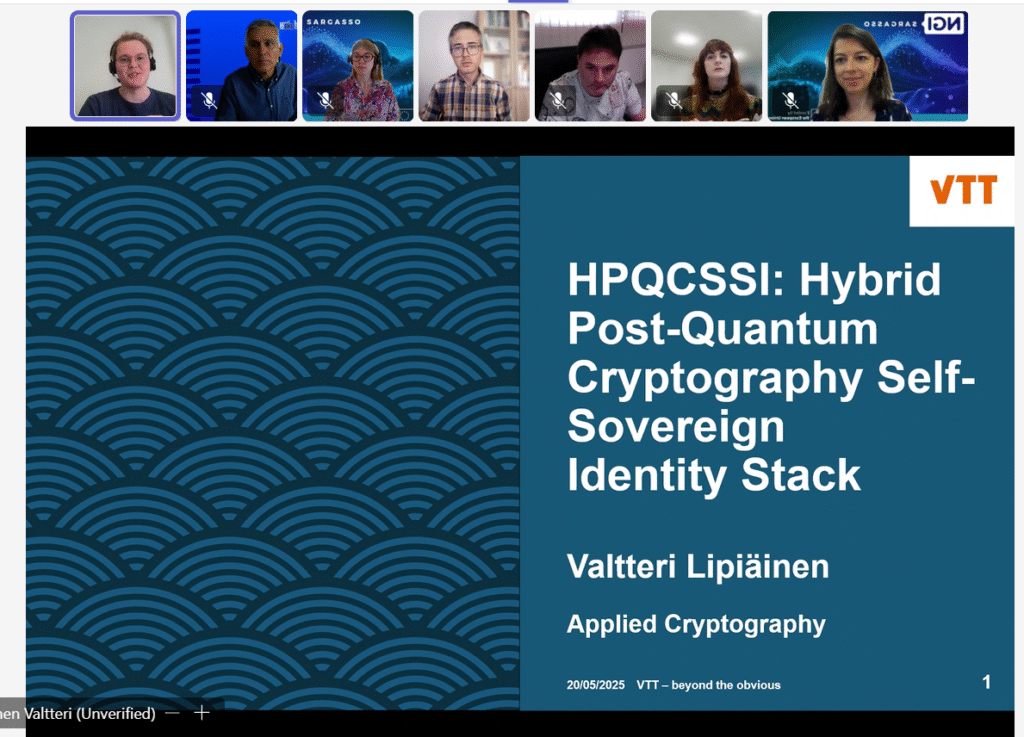
HPQCSSI: Hybrid Post-Quantum Cryptography Self-Sovereign Identity Stack
https://youtu.be/AycpKklJHng
Valtteri Lipiäinen, Research Scientist at VTT, represented HPQCSSI, a project from our second open call combining the quantum safe security of post-quantum cryptography (PQC) with the modern digital identity movement of self-sovereign identity (SSI). By integrating the SSI stack with quantum-resistant algorithms, HPQCSSI aims to bridge digital identity solutions between the EU and USA, ensuring long-term security and interoperability.
HPQCSSI is partnered by VTT Technical Research Centre of Finland and OHIO University (USA).
QRISTIN: Quantum Routines In Space-Terrestrial Integrated Networks
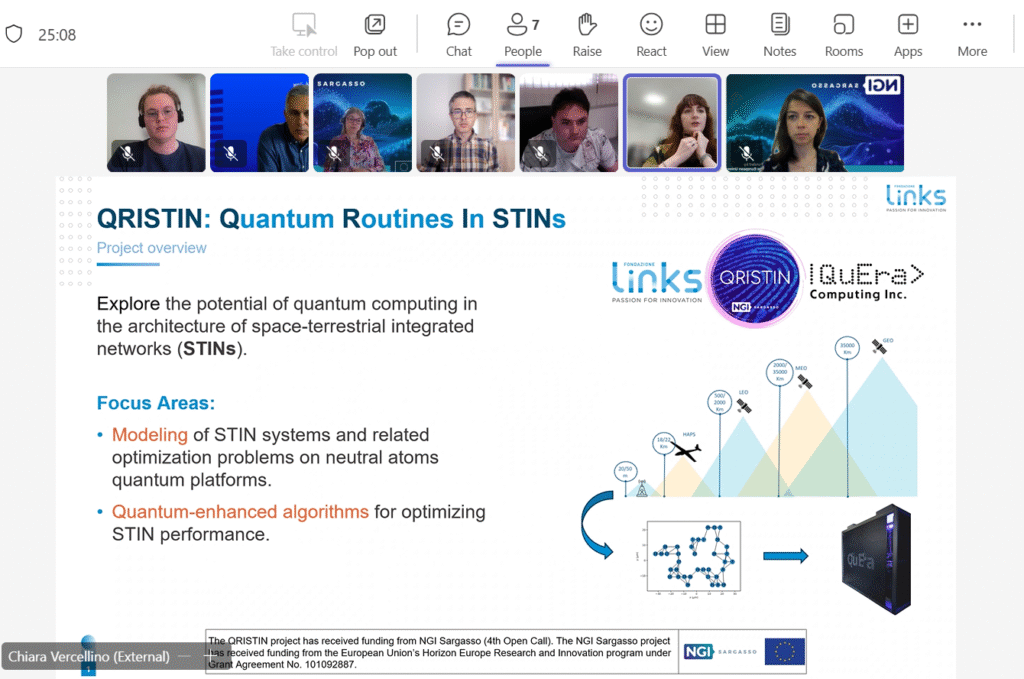
Chiara Vercellino, Researcher at Links Foundation, explained her project from our open call four: QRISTIN.
The QRISTIN project seeks to harness the power of quantum algorithms to tackle intricate combinatorial optimization problems within space terrestrial integrated networks (STINs), specifically focusing on improving resource management and routing strategies.
The QRISTIN project leverages quantum algorithms to address complex combinatorial optimization challenges within STIN. While STIN offers inherent advantages like flexibility and larger bandwidth over terrestrial networks, integrating satellite networks efficiently poses challenges, particularly in developing algorithms for resource management and routing strategies. Quantum computing’s ability to solve hard computational problems complements classical solutions, making it a promising choice.
QRISTIN is partnered by Fondazione LINKS – Leading Innovation & Knowledge for Society (Italy) and QuEra Computing Inc (USA).
FRQGAN4AD: Federated and Robust Quantum Generative Adversarial Networks for Anomaly Detection in Future Internet
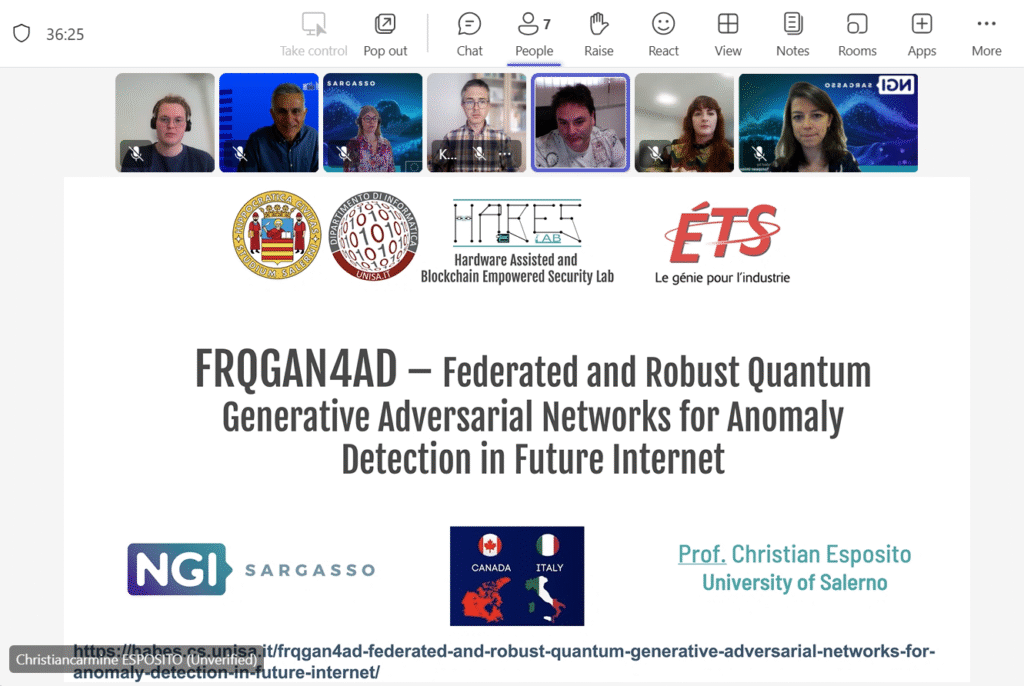
Christian Esposito, Associate Professor at Università degli Studi di Salerno, introduced FRQGAN4AD, a project also selected in our fourth open call, devoted to exploiting Quantum Generative AI to improve anomaly detection when analyzing traffic traces to identify attacks in the Next Generation Internet and devise a federated and robust approach to cope with the quantum noise and the large scale of the network under analysis.
Christian and his team of innovators aim to investigate how quantum computing can improve Generative Adversarial Networks (GANs) and how to have a federated approach to QGAN in large networks that have a wide variety of traffic and are susceptible to a large number of potential attacks.
FRQGAN4AD is partnered by University of Salerno (Italy) and École de Technologie Supérieure de Montréal (Canada).
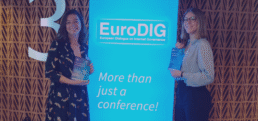
NGI Sargasso Joins EuroDIG 2025: The European Dialogue on Internet Governance
"An inspiring edition putting Human Rights as the highest priority" - Mariette Vandermersch-Desmartin, Mission Coordinator at European Science Foundation (ESF).
This is the quote summarizing what EuroDIG 2025 was according to Mariette Vandermersch-Desmartin, Mission Coordinator at European Science Foundation (ESF), the NGI Sargasso project coordinator.
The 2025 edition of the European Dialogue on Internet Governance (EuroDIG) took place in Strasbourg (France) under the theme: 'Safeguarding Human Rights while Balancing Regulation and Innovation'. The ESF team, represented by Mariette, together with Hélène Schaffner, Bilingual English Administrator, participated on behalf of NGI Sargasso, and they were impressed by the quality and diversity of speakers and discussions.
Mariette and Hélène jumped into conversations about Next Generation Internet (NGI) and Internet Governance, while networked with other participants to explain how our NGI Sargasso Innovators are building an Internet of humans with their projects supported by our cascade funding program. Their discussions on standardization, digital identity, and cybersecurity were notably of great interest for the NGI Sargasso community.
EuroDIG 2025 reaffirmed the essential role of multi-stakeholder dialogue in shaping the future of Internet Governance. The need for robust and forward-looking standardization frameworks –especially concerning NGI– was a recurring theme across sessions, reflecting Europe's commitment to building a secure, interoperable, and rights-respecting digital future.
More about EuroDIG 2025: 'Safeguarding Human Rights while Balancing Regulation and Innovation'
The European Dialogue on Internet Governance (EuroDIG) is an open multi-stakeholder platform to exchange views about the Internet and how it is governed. First organized in 2008 by several organisztions, government representatives and experts, it fosters dialogue and collaboration with the Internet community on public policy for the Internet –culminating in an annual conference that takes place in a different European city every year. EuroDIG ‘Messages’ are prepared and presented to the Internet Governance Forum (IGF).
In 2025 EuroDIG took place from May 12 – 14 in Strasbourg (France), hosted by the Council of Europe in cooperation with the Luxembourg Presidency of the Committee of Ministers of the Council of Europe.