Last month, on the 20th of May 2025, three NGI Sargasso-funded projects developing quantum related technologies met online in a session organized by the NGI Sargasso consortium to find synergies and connect:
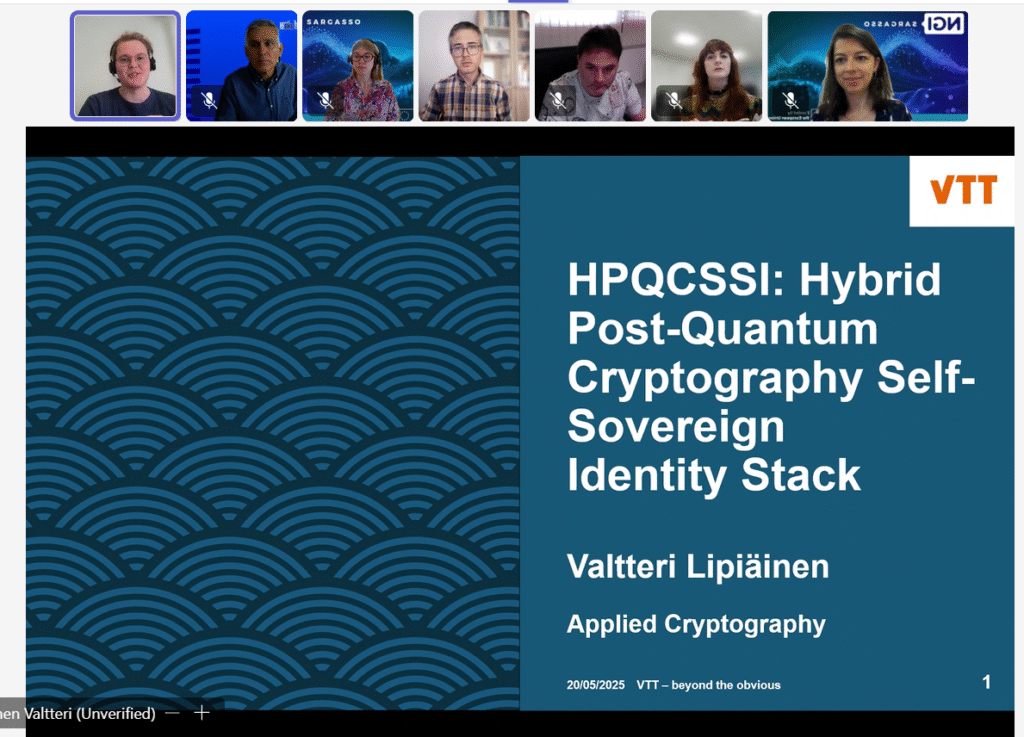
- HPQCSSI: Hybrid Post-Quantum Cryptography Self-Sovereign Identity Stack
- QRISTIN: Quantum Routines In Space-Terrestrial Integrated Networks
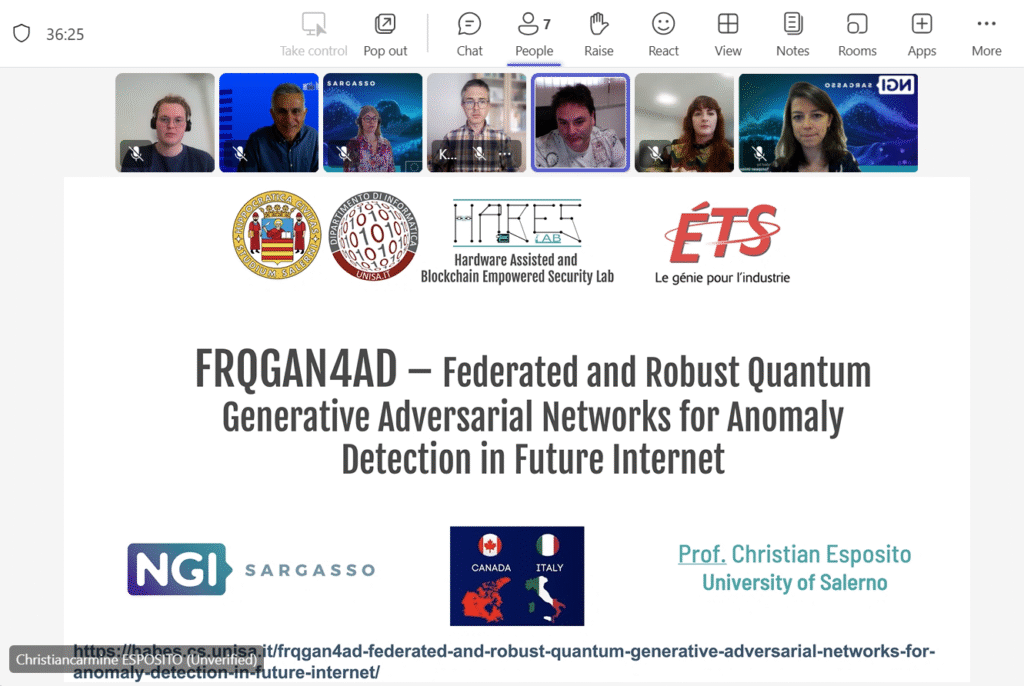
- FRQGAN4AD: Federated and Robust Quantum Generative Adversarial Networks for Anomaly Detection in Future Internet
Each of them had ten minutes to introduce themselves and five minutes for questions and discussion.
HPQCSSI: Hybrid Post-Quantum Cryptography Self-Sovereign Identity Stack
Valtteri Lipiäinen, Research Scientist at VTT, represented HPQCSSI, a project from our second open call combining the quantum safe security of post-quantum cryptography (PQC) with the modern digital identity movement of self-sovereign identity (SSI). By integrating the SSI stack with quantum-resistant algorithms, HPQCSSI aims to bridge digital identity solutions between the EU and USA, ensuring long-term security and interoperability.
HPQCSSI is partnered by VTT Technical Research Centre of Finland and OHIO University (USA).
QRISTIN: Quantum Routines In Space-Terrestrial Integrated Networks
Chiara Vercellino, Researcher at Links Foundation, explained her project from our open call four: QRISTIN.
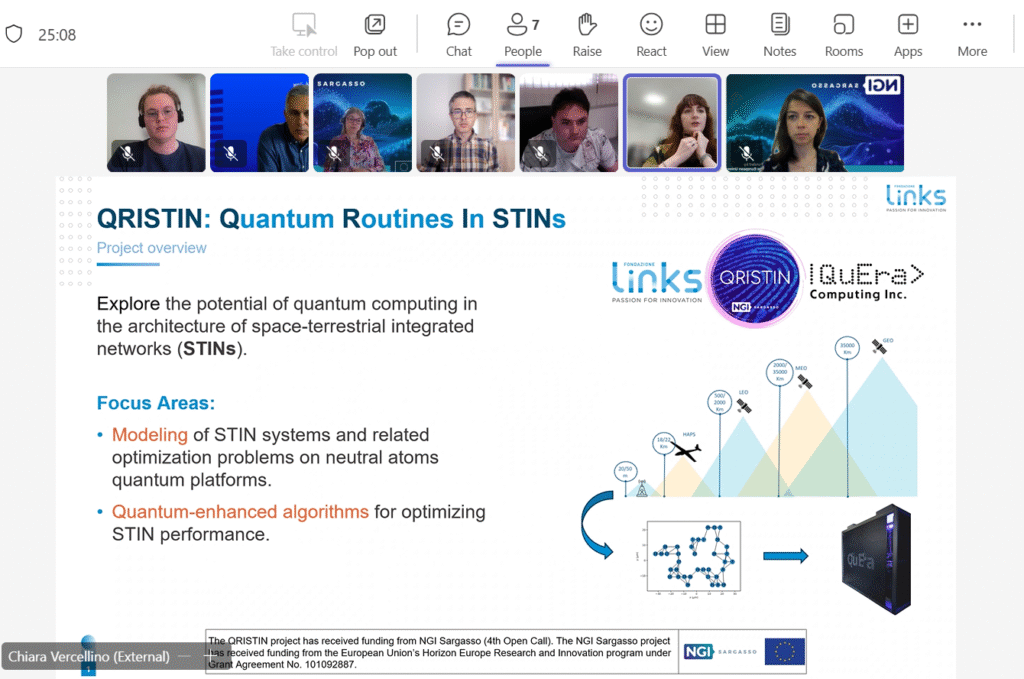
The QRISTIN project seeks to harness the power of quantum algorithms to tackle intricate combinatorial optimization problems within space terrestrial integrated networks (STINs), specifically focusing on improving resource management and routing strategies.
The QRISTIN project leverages quantum algorithms to address complex combinatorial optimization challenges within STIN. While STIN offers inherent advantages like flexibility and larger bandwidth over terrestrial networks, integrating satellite networks efficiently poses challenges, particularly in developing algorithms for resource management and routing strategies. Quantum computing’s ability to solve hard computational problems complements classical solutions, making it a promising choice.
QRISTIN is partnered by Fondazione LINKS – Leading Innovation & Knowledge for Society (Italy) and QuEra Computing Inc (USA).
FRQGAN4AD: Federated and Robust Quantum Generative Adversarial Networks for Anomaly Detection in Future Internet
Christian Esposito, Associate Professor at Università degli Studi di Salerno, introduced FRQGAN4AD, a project also selected in our fourth open call, devoted to exploiting Quantum Generative AI to improve anomaly detection when analyzing traffic traces to identify attacks in the Next Generation Internet and devise a federated and robust approach to cope with the quantum noise and the large scale of the network under analysis.
Christian and his team of innovators aim to investigate how quantum computing can improve Generative Adversarial Networks (GANs) and how to have a federated approach to QGAN in large networks that have a wide variety of traffic and are susceptible to a large number of potential attacks.
FRQGAN4AD is partnered by University of Salerno (Italy) and École de Technologie Supérieure de Montréal (Canada).